Expert guides, trends, and knowledge on commercial stainless steel kitchenware manufacturing.
Discover tips and developments in high-quality daily kitchen tools and gadgets.
Industry standards and best practices for hotel and catering equipment buyers.
Global hospitality is recovering, but hotel kitchens are becoming more demanding. UN Tourism reported approximately 1.4 billion international tourist arrivals in 2024. That figure reached about 99% of 2019 levels. WTTC’s 2025 Economic Impact Research also estimated that travel and tourism generated $11.1 trillion globally in 2024. More guests mean more breakfasts, room-service orders, banquets, and urgent cleaning cycles.
For purchasing teams, Hotel Kitchenware Supplies are not simple decorative items. They influence food safety, preparation speed, labor efficiency, and replacement costs. A hotel may need heavy-duty stainless-steel cookware, induction-ready pans, heat-resistant utensils, stackable storage containers, and durable serving equipment. Each item must match the kitchen’s menu, workflow, equipment, and local compliance requirements.
Industry research supports this pressure. Grand View Research identifies continued growth in commercial kitchen equipment, driven by hospitality expansion, energy efficiency, and food-service modernization. However, broad market figures do not guarantee good buying decisions. A polished product page can hide thin handles, weak welds, or unclear material grades. That is where buyers must slow down.
This guide reviews 10 Best Hotel Kitchenware Supplies for Global Buyers through a practical purchasing lens. It considers durability, hygiene, operating temperature, maintenance, supplier consistency, and total cost of ownership. Stainless steel is not automatically superior. The cheapest option may become expensive after repeated replacement. Small details matter: a pan that warps on induction, or a container lid that fails during transport, can disrupt an entire service.
No list fits every hotel. Still, these recommendations offer a reliable starting point for comparing suppliers, specifications, and long-term kitchen performance.
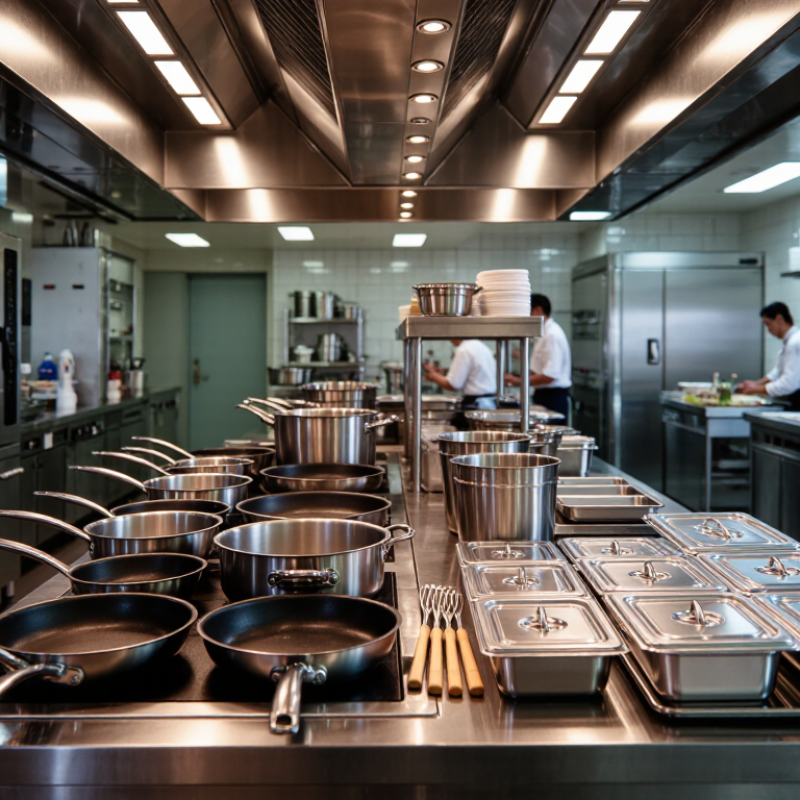
Hotel kitchenware supplies cover cookware, knives, serving tools, storage containers, racks, dishwashing items, and food-preparation equipment. They also include thermometers, cutting boards, trays, and heat-resistant gloves. Each item supports speed, hygiene, and consistent guest service.
The FDA Food Code 2022 recommends food-contact surfaces that are smooth, durable, nonabsorbent, and easy to clean. This makes material selection a practical safety decision, not merely a design choice. Stainless steel often performs well, but thickness, weld quality, and handle strength still require inspection. One overlooked detail can create replacement costs.
Energy use also matters. The U.S. Department of Energy reports that restaurants can consume five to seven times more energy per square foot than other commercial buildings. Hotels should therefore assess induction units, insulated containers, and efficient dishwashing tools. The UNEP Food Waste Index Report 2024 estimated 1.05 billion tonnes of food waste in 2022. Better portion tools and sealed storage may reduce avoidable waste, although results depend on staff habits.
Tips: Build a room-by-room checklist. Match supplies to menu volume, shift patterns, and cleaning capacity. Small details matter. Test samples before bulk purchasing.
What hotel kitchenware supplies include and why they matter
The chart compares ten essential hotel kitchenware categories using a practical procurement priority index. The index considers hygiene, durability, versatility, operational frequency, and replacement needs in commercial kitchens. Stainless steel containers, knives, cutting boards, and food storage containers rank highly because they support food safety, daily preparation, and efficient kitchen organization.
Evaluating kitchenware for commercial hotel operations requires more than checking unit price. Procurement teams should test pans, knives, utensils, trays, and storage containers under real service pressure. A breakfast kitchen may move hundreds of plates within two hours, so handles must remain secure, surfaces must resist scratching, and items must fit existing racks. Measure before ordering.
Food safety should guide every specification. The FDA Food Code 2022 recommends holding hot food at 57°C (135°F) or above, and cold food at 5°C (41°F) or below. Kitchenware should support these limits through suitable materials, stable lids, and reliable heat transfer. Ask suppliers for test records, material declarations, and cleaning instructions. “Food-grade” alone is too vague.
Energy and waste also affect long-term value. The U.S. EPA ENERGY STAR program reports that commercial kitchens can use about 2.5 times more energy per square foot than other commercial spaces. Lightweight cookware may reduce handling effort, but it can deform sooner under constant heat. That trade-off deserves testing. The UNEP Food Waste Index Report 2024 estimated 1.05 billion tonnes of food waste in 2022, with food service responsible for 28%. Portion-control tools, stackable containers, and clear date labels can reduce avoidable waste. Some evaluations still focus too heavily on appearance. That is a mistake. A quieter, heavier tray may outperform a cheaper one after years of washing.
Global hotel kitchens need more than attractive tools. They need durable, safe, and replaceable supplies. The 10 essential hotel kitchenware categories are cookware, bakeware, knives, cutting boards, utensils, tableware, glassware, food-storage containers, serving ware, and cleaning supplies. Each category supports a different service moment, from breakfast preparation to late-room dining.
Choose stainless steel cookware for busy lines and heat-resistant utensils for repeated use. Knives should balance grip, edge retention, and easy sanitation. Color-coded cutting boards can reduce handling errors. The 2022 FDA Food Code stresses smooth, durable, and easily cleanable food-contact surfaces. That matters in high-volume kitchens. The WHO estimates that contaminated food causes about 600 million illnesses globally each year, so storage containers need secure lids and clear date labels. Tableware and glassware should be stackable, while serving ware must tolerate frequent washing. Food-storage performance is often overlooked.
Energy use also affects purchasing. ENERGY STAR reports that certified commercial foodservice equipment can use 10% to 50% less energy, depending on the product category. Still, lower consumption does not always mean better workflow. I have seen kitchens buy efficient equipment that slows service because capacity was underestimated.
Tips: Test representative items during a busy shift. Check handle comfort, stacking space, cleaning time, and replacement availability. Request food-contact documentation and regional electrical specifications. Do not buy ten categories from one specification sheet; real kitchens expose weaknesses quickly.
| No. | Supply Category | Representative Items | Common Food-Contact Materials | Primary Hotel Use | Key Procurement Dimensions | Recommended Buying Unit |
|---|---|---|---|---|---|---|
| 1 | Commercial Cookware | Stock pots, saucepans, sauté pans, frying pans, braising pans and lids | Stainless steel, aluminum with a stainless-steel base, or multi-layer metal construction | Bulk cooking, sauce preparation, boiling, frying and banquet production | Capacity, base compatibility, wall thickness, handle strength, lid fit, heat distribution and dishwasher suitability | Piece or matched size set |
| 2 | Food Preparation Tools | Chef’s knives, paring knives, peelers, graters, whisks, tongs, spatulas and ladles | Stainless steel, food-grade polypropylene, nylon, silicone and heat-resistant composite handles | Daily preparation, portioning, mixing, turning and serving-line support | Blade hardness, edge retention, handle ergonomics, heat resistance, color coding and storage safety | Piece, six-piece kit or workstation set |
| 3 | Food Storage Containers | Ingredient bins, stackable containers, gastronorm pans, lids and portion containers | Food-grade polypropylene, polycarbonate, polyethylene and stainless steel | Refrigerated storage, dry goods organization, mise en place and buffet service | Capacity, footprint, stackability, lid sealing, temperature range, transparency and labeling area | Piece, container-and-lid pair or nesting set |
| 4 | Baking and Pastry Equipment | Sheet pans, cake pans, loaf pans, mixing bowls, pastry brushes and cooling racks | Aluminized steel, stainless steel, food-grade silicone and heat-resistant glass | Bread, desserts, breakfast pastries, banquet baking and room-service production | Pan dimensions, rim design, maximum oven temperature, surface durability, nesting efficiency and cleaning method | Piece, baking tray pack or pastry set |
| 5 | Serving and Buffetware | Serving trays, chafer pans, serving spoons, tongs, condiment holders and display bowls | Stainless steel, tempered glass, porcelain, melamine and food-grade plastic | Breakfast buffets, banquets, catering events, restaurants and lounge service | Serving capacity, presentation style, heat retention, stability, stackability and replacement-part availability | Piece, matching buffet set or service station set |
| 6 | Tableware and Guest Dining Items | Plates, bowls, cups, saucers, cutlery, teaspoons and service accessories | Vitrified porcelain, stoneware, tempered glass and stainless steel | Guest rooms, restaurants, banquets, breakfast areas and in-room dining | Stack height, chip resistance, thermal shock resistance, weight, design consistency and washing compatibility | Piece, dozen or complete place setting |
| 7 | Bar and Beverage Serviceware | Tumblers, stemware, pitchers, shakers, strainers, jiggers and ice buckets | Tempered glass, borosilicate glass, stainless steel and food-grade plastic | Bars, restaurants, meeting rooms, pool areas and guest-room beverage service | Volume, rim strength, breakage resistance, clarity, thermal performance and ease of polishing | Piece, dozen or bar-tool set |
| 8 | Measuring and Portion-Control Tools | Measuring cups, measuring spoons, portion scoops, kitchen scales and thermometers | Stainless steel, food-grade plastic, silicone and tempered glass | Recipe consistency, buffet portioning, inventory control and food-safety monitoring | Measurement range, readability, calibration capability, accuracy, unit conversion and waterproof construction | Piece, calibrated tool or measurement set |
| 9 | Kitchen Utensil and Hand-Tool Storage | Knife racks, utensil holders, wall rails, shelving bins, drain racks and mobile carts | Stainless steel, aluminum, coated steel and food-grade polymer components | Organized storage, workflow improvement, drying and transport between preparation areas | Load capacity, dimensions, drainage, corrosion resistance, mobility, wall-mount requirements and cleanability | Piece, rack system or mobile unit |
| 10 | Cleaning and Food-Safety Accessories | Dish brushes, cleaning scrapers, color-coded boards, drain baskets, soap dispensers and waste containers | Stainless steel, polypropylene, silicone, nylon bristles and high-density polyethylene | Cross-contamination control, equipment cleaning, waste handling and hygienic workstation maintenance | Color coding, chemical resistance, bristle durability, drainage, non-porous surfaces and replacement frequency | Piece, color-coded set or hygiene station kit |
Global purchasing note: Confirm food-contact compliance, electrical compatibility where applicable, temperature ratings, packaging requirements, import documentation and destination-market hygiene regulations before placing an order.
Hotel kitchenware should fit the operation, not just the purchasing list. The ten core supplies include chef knives, cutting boards, stockpots, frying pans, hotel pans, mixing bowls, sheet trays, ladles, food thermometers, and storage containers. In my experience, a small guesthouse needs compact cookware, stackable bowls, and fewer duplicate tools. A 300-room hotel needs deeper stockpots, multiple pan sizes, reinforced handles, and extra thermometers for busy shifts. Small details matter.
A breakfast-focused property may prioritize griddles, sheet trays, tongs, and sealed storage containers. A full-service hotel needs durable knives, saucepans, sauté pans, roasting trays, and accurate temperature tools. Room service also benefits from lightweight pans and containers that travel safely. Check food-contact requirements, heat ratings, dishwasher compatibility, and replacement availability before ordering. Requirements differ between markets, so local verification is essential.
Buying only by unit price can create expensive problems. Cheap cutting boards may warp, while weak pan handles can slow service. I once underestimated storage space and ordered too many large containers. The kitchen looked prepared, but staff lost time searching for smaller sizes. A practical purchase plan should compare daily covers, peak-hour demand, storage capacity, and cleaning routines. Leave some flexibility. Forecasts are useful, but hotel service rarely follows them perfectly.
Global buyers should compare kitchenware suppliers through evidence, not polished catalog photos. Request material specifications, food-contact declarations, test reports, and production samples. A stainless-steel pan may look identical to another, yet thickness, handle welding, and heat distribution can differ greatly.
Check whether the supplier understands the destination market’s applicable safety and labeling requirements. Ask for batch traceability, inspection procedures, carton dimensions, and replacement policies. Reliable suppliers answer clearly and provide consistent documents. Vague claims deserve caution. So do samples that feel unusually light.
Cost comparison must include the full landed price. Add tooling, packaging, freight, insurance, duties, inspection fees, and possible breakage. Compare the same quantities and delivery terms. A lower unit price can hide higher waste, slower service, or frequent replacement. The cheapest quote can look brilliant—until it isn’t.
For hotel kitchens, test products under realistic pressure. Stack storage containers, open lids repeatedly, and inspect knife edges after routine use. Measure cooking surfaces and check whether fittings remain stable after washing. I find supplier scoring useful, but never perfect. Product quality, communication, and delivery reliability can change between orders. Record every promise in writing, including tolerances, lead times, and corrective actions. Editorial photos cannot replace a controlled sample review.
Essential categories include cookware, bakeware, knives, cutting boards, utensils, tableware, glassware, storage containers, serving ware, and cleaning supplies. Each category supports a different service moment.
Small guesthouses need compact cookware, stackable bowls, and fewer duplicate tools. Larger hotels need deeper stockpots, multiple pan sizes, reinforced handles, and extra thermometers. Capacity changes everything.
Prioritize griddles, sheet trays, tongs, mixing bowls, and sealed storage containers. Choose stackable items when shelves are narrow. Breakfast service moves quickly.
Stainless steel cookware handles repeated use and frequent washing. Pans should have comfortable handles, suitable capacity, and reliable heat performance. Small handles can slow service.
Select smooth, durable, and easily cleanable food-contact surfaces. Use color-coded cutting boards to reduce handling errors. Storage containers need secure lids and clear date labels.
Knives should balance grip, edge retention, and easy sanitation. Utensils need heat-resistant materials for repeated cooking. Test comfort during an actual busy shift.
Check stacking space, dishwasher compatibility, cleaning time, and replacement availability. Measure shelves before ordering large containers. I once underestimated storage needs.
No. Efficient equipment can still slow service when capacity is too small. Compare energy use with workflow, peak demand, and available space. Efficiency is not the whole answer.
Hotel Kitchenware Supplies are essential to the efficiency, safety, and guest experience of any hospitality operation. This guide explains what these supplies include, from cookware, utensils, and food preparation tools to serving equipment, storage containers, cleaning accessories, and specialized items for baking or buffet service. It also outlines how to evaluate durability, heat resistance, ease of cleaning, ergonomic design, food-contact safety, and suitability for continuous commercial use.
The article presents ten key kitchenware supply categories and shows how requirements differ according to hotel size, menu complexity, kitchen layout, and service style. It also helps global buyers compare suppliers by reviewing product consistency, material specifications, quality control, packaging, lead times, customization options, certifications, and total cost rather than unit price alone. With a structured purchasing approach, hotels can select reliable equipment that supports smooth operations, reduces replacement expenses, and maintains consistent service standards across different markets.