
0%

Choosing the best Professional Chef Utensils manufacturers in China requires more than comparing prices or polished catalog images. Professional kitchens depend on tools that survive heat, pressure, moisture, and constant washing. A reliable manufacturer should show practical production experience, stable material sourcing, skilled workers, and clear quality controls.

Stainless steel grade matters. Handle balance matters too. A ladle should feel steady during long service, while a whisk needs flexible wires that resist deformation. Good suppliers can explain these details without hiding behind vague claims. They should provide material specifications, sample testing, factory information, and transparent production timelines. Independent inspections can also confirm dimensions, surface finishing, packaging, and order consistency.

Not every experienced factory is perfect. Some may offer excellent metalwork but limited design support. Others may communicate well but struggle with small-batch orders. That difference is important. Buyers should review samples under real kitchen conditions, not only inspect photographs. Check welds, edges, grip comfort, polishing quality, and resistance to repeated cleaning. Food-contact compliance should be verified through appropriate documentation for the target market.

China offers a broad manufacturing base, from specialized utensil workshops to large export-oriented facilities. The right partner depends on your product range, order volume, branding needs, and delivery expectations. This guide examines manufacturers through evidence, not slogans. It considers craftsmanship, production capacity, customization, quality assurance, and customer feedback. Some conclusions may change after direct factory visits or updated testing. That is part of responsible sourcing. A dependable supplier earns trust gradually, one consistent batch at a time.
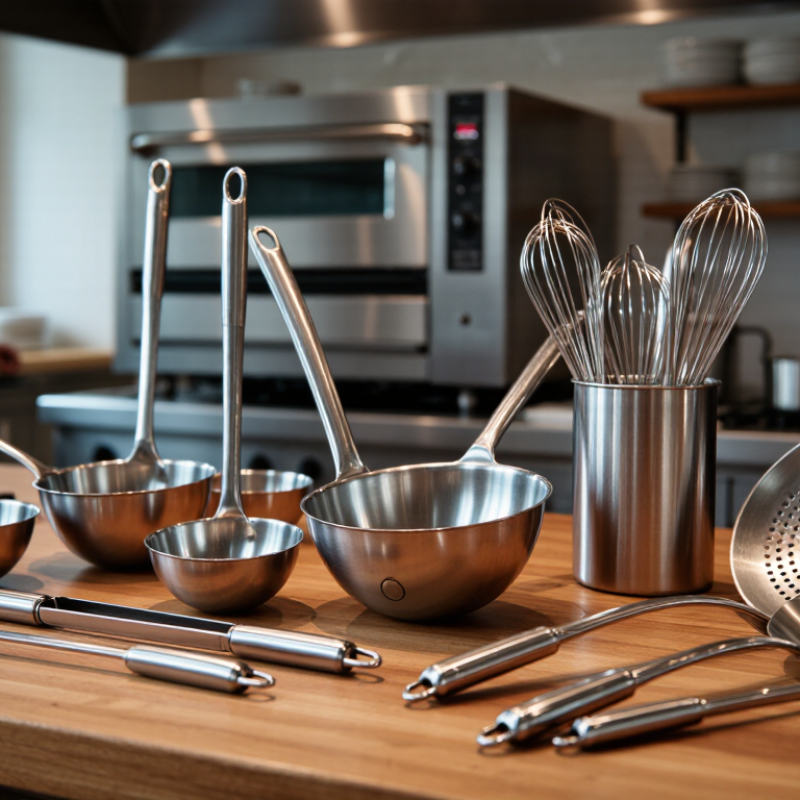
Best Professional Chef Utensils Manufacturers in China

What Defines a Professional Chef Utensil Manufacturer in China

A professional chef utensil manufacturer in China must offer more than attractive stainless-steel tools. It needs controlled production, measurable testing, and reliable documentation. China’s catering revenue reached about RMB 5.57 trillion in 2024, according to the National Bureau of Statistics. That scale creates strong demand for utensils that survive repeated commercial washing, heat, and impact.

Material control is a practical dividing line. Manufacturers should identify steel grades, aluminum alloys, silicone compounds, and surface treatments by batch. They should also provide food-contact test records under applicable Chinese GB 4806 requirements. ISO 9001 certification can support process discipline, but certification alone proves little. Buyers should inspect calibration records, incoming-material checks, production samples, and corrective-action reports. The 2023 ISO Survey recorded more than 1.26 million ISO 9001 certificates worldwide, showing its value as a common framework, not a complete quality guarantee.

Experienced factories understand kitchen behavior. Handles must remain stable with wet hands. Edges need smooth finishing. Ladles should balance naturally over a stockpot. A serious supplier can explain its mold life, sampling process, packaging tests, and traceability system without vague promises. Small details matter.

No factory is flawless. Even strong manufacturers may show uneven polishing or delayed documentation during busy periods. That is why independent inspections and repeated sample checks remain necessary. The best partner combines engineering evidence, responsive communication, and honest limits.

Key Criteria for Evaluating Chinese Chef Utensil Manufacturers

Evaluating Chinese chef utensil manufacturers requires more than comparing catalog prices. World Stainless reported that China produced about 36.7 million tonnes of crude stainless steel in 2023, nearly 63% of global output. This capacity supports strong material availability, but it does not guarantee precise utensils. Buyers should verify steel grades, hardness, wall thickness, weld quality, and surface polishing through batch records and laboratory reports. Food-contact compliance should match applicable requirements, including China’s GB 4806.9 standard for metal materials. Ask for traceability from steel coil to packed utensil.

Production control matters just as much. The ISO Survey 2022 recorded China as the largest national holder of ISO 9001 certificates, yet certification alone proves limited operational detail. Request process maps, inspection plans, defect limits, calibration records, and recent corrective-action reports. Inspect cutting edges, rivets, handles, and hanging holes on physical samples. A sample can deceive. Review at least three production batches when possible. Check whether the factory controls polishing internally or outsources it without documented oversight. That weakness is easy to miss.

Capacity should be tested against your order, not advertised monthly output. Compare equipment lists with actual workshop observations, staffing, lead times, and peak-season performance. Independent pre-shipment inspection can verify quantity, dimensions, finish, packaging, and random-function tests. I would also challenge unusually perfect defect rates; honest manufacturers usually record minor failures and explain how they reduced them. One practical mistake is focusing too heavily on price. A cheaper utensil may require thicker packaging, more replacements, and additional inspection later.

Major Product Categories and Manufacturing Capabilities

Best Professional Chef Utensils Manufacturers in China

China’s professional chef utensil sector covers more than spoons and ladles. Major categories include stainless steel tongs, forged knives, silicone spatulas, wire whisks, measuring tools, bakery accessories, and food-storage utensils. Grand View Research reports that the global commercial kitchen equipment market is expanding steadily, driven by restaurants, hotels, and institutional catering. This growth increases demand for durable, cleanable tools with consistent dimensions.

Manufacturing capabilities vary widely. Experienced factories combine stamping, forging, injection molding, CNC machining, laser welding, polishing, and passivation. Stainless steel utensils may receive brushed or mirror finishes, while silicone tools require controlled molding temperatures and hardness testing. Some manufacturers also provide custom molds, logo-free packaging, sample development, and batch traceability. According to Fortune Business Insights, Asia-Pacific remains a major production region for foodservice equipment, supported by extensive metalworking and supply-chain capacity.

Quality control should be visible, not merely promised. Buyers can request material certificates, surface inspections, pull tests, dishwasher-cycle testing, and food-contact documentation. The BRCGS Global Food Safety Report highlights traceability and process control as practical foundations for safer manufacturing. A polished handle proves little by itself. Not every attractive sample survives daily kitchen abuse. I have seen thin welds, loose rivets, and uncomfortable grips pass casual inspection. Supplier audits, pilot orders, and repeated-use testing expose those weaknesses earlier. One detail matters: edges must feel smooth, even after production scaling.

How to Compare Quality, Certifications, and Customization Services

Best Professional Chef Utensils Manufacturers in China

When comparing professional chef utensil manufacturers in China, inspect materials before judging prices. For stainless steel tools, verify the stated grade, such as 304 or 430, through mill certificates or independent testing. Check welds, rivets, edges, and handle connections by hand. Smooth surfaces matter. A rough seam can trap food residue and weaken during washing. Ask for sample testing after repeated heat cycles, dishwasher use, and drop resistance. One attractive sample proves very little.

Certifications should match the product, factory, and target market. Review ISO 9001 records, food-contact test reports, and applicable FDA or LFGB documentation. Do not accept certificates with unclear laboratory details or mismatched company names. Request recent reports with batch numbers and test methods. During a factory audit, compare the approved sample with mass-production items. Small differences often appear in polishing, thickness, or packaging. This step is easily missed.

Customization requires more than printing a logo. Discuss drawings, dimensions, steel thickness, handle materials, color limits, packaging, and minimum order quantities. Ask whether the manufacturer controls tooling and final inspection internally. A reliable supplier should provide a prototype, production timeline, tolerance range, and corrective-action process. I would also request a pre-shipment inspection with photos and random measurements. Mistakes still happen. Even experienced buyers sometimes approve designs before testing comfort, balance, and cleaning practicality. A useful comparison sheet should record every result, not only the lowest quotation.

Steps for Selecting the Right Chinese Manufacturing Partner

Choosing the right Chinese manufacturing partner requires more than comparing prices. A polished factory tour can still hide weak production controls. Request business licenses, export experience, material certificates, and recent inspection records. Verify the workshop address and production capacity through a live video call or an independent audit. Useful evidence matters.

Ask for samples made with the same stainless steel grade, handle material, and finishing process planned for mass production. Check edges, welds, balance, grip comfort, and resistance to staining after repeated washing. For food-contact utensils, review testing procedures and traceability records carefully. Do not accept vague claims about safety or durability.

Evaluate the partner’s communication before signing an order. Do they answer technical questions clearly? Can they explain tooling costs, minimum order quantities, lead times, packaging, and quality tolerances? A fast reply is not always a reliable reply. Keep written specifications. Confirm who approves samples and who pays for corrective work.

Use a small pilot order before committing to large volumes. Measure defects, packing damage, delivery accuracy, and response speed. A factory may perform well on samples but struggle during peak production. That gap deserves attention. I would also ask for a realistic production schedule, not an optimistic promise. Good partners disclose limitations early, even when the answer is inconvenient.

Best Professional Chef Utensils Manufacturers in China: Partner Selection Priorities

A practical evaluation framework for comparing Chinese manufacturing partners. The percentages represent suggested purchasing priorities for professional chef utensils and are not company-specific data.

Prioritize food-contact compliance and product quality first, then verify production capability, delivery performance, documentation, and communication before placing an order.

FAQS

What defines a professional chef utensil manufacturer in China?

It controls materials, production, testing, and documentation. It should explain batch tracking, sample checks, mold life, and packaging tests. Vague promises are warning signs.

Which materials should buyers verify?

Verify stainless-steel grades, aluminum alloys, silicone compounds, and surface treatments. Request batch records or independent test results. A shiny finish proves little.

How can buyers check utensil durability?

Test tools after repeated heat cycles, commercial washing, and controlled drops. Inspect welds, rivets, edges, and handles by hand. Small defects matter.

What food-contact documents should a supplier provide?

Request current food-contact test reports under applicable GB 4806 requirements. Check laboratory details, test methods, batch numbers, and matching company information. Documents need checking too.

Does quality certification guarantee reliable products?

No. Certification supports process discipline but cannot replace product testing. Review calibration records, incoming-material checks, corrective actions, and production samples.

What details matter when reviewing utensil design?

Handles should remain stable with wet hands. Edges should feel smooth. Ladles should balance over a stockpot, while seams should resist food buildup and washing damage.

What should customization discussions include?

Confirm drawings, dimensions, steel thickness, handle materials, packaging, and minimum order quantities. Ask for prototypes, tolerance ranges, timelines, and internal tooling control. Logo printing alone is not customization.

How should buyers inspect mass production?

Compare production items with the approved sample. Measure thickness, polishing, dimensions, and packaging randomly. A pre-shipment inspection helps, but repeated checks remain useful. No factory is flawless.

Conclusion

China’s professional chef utensil manufacturers are defined by their ability to combine reliable production, skilled craftsmanship, strict quality control, and flexible customer support. The best suppliers typically offer a broad range of Professional Chef Utensils, including knives, cookware, kitchen tools, baking equipment, and food preparation accessories. Their manufacturing capabilities may cover material selection, forging, stamping, machining, polishing, heat treatment, assembly, and packaging, allowing them to meet different commercial kitchen requirements.

When evaluating Chinese manufacturers, buyers should compare product quality, production capacity, certifications, inspection procedures, lead times, and customization services. A dependable partner should communicate clearly, provide samples, support private labeling or tailored designs, and maintain consistent standards across large orders. The selection process should begin with defining product needs, followed by supplier research, factory assessment, sample testing, quotation comparison, and contract review. Choosing a manufacturer that combines technical expertise, transparent processes, and responsive service can help ensure long-term cooperation and dependable kitchen products.

Olivia Carter

Olivia Carter

Olivia Carter is a highly accomplished marketing professional dedicated to helping businesses communicate their value with clarity, confidence, and purpose. With extensive experience in market research, content strategy, customer engagement, and digital communications, she brings both strategic......