
0%

Choosing a stainless steel kitchenware manufacturer affects product safety, appearance, cost, and long-term customer trust. A polished sample may look impressive under showroom lights. It may still hide weak welds, uneven thickness, or poor edge finishing. The right decision requires more than comparing quotations.

This guide explains how Stainless Steel Kitchenware Manufacturing should be assessed in practical terms. Look for experience with food-contact products, suitable stainless steel grades, and stable production controls. Ask whether the manufacturer can provide material certificates, inspection records, and batch traceability. Factory visits can reveal details that websites often omit, such as surface cleanliness, storage conditions, and worker handling practices. Samples should be tested for balance, lid fit, handle strength, and resistance to stains after repeated washing.

Reliable suppliers also communicate clearly about tooling, minimum order quantities, lead times, packaging, and corrective actions. A professional manufacturer will explain limitations instead of promising everything immediately. That matters. Even experienced buyers can overlook small defects when deadlines become urgent. I have found that production photos are useful, but they never replace independent inspection or documented quality checks. Pricing deserves careful review, too. An unusually low quote may reflect thinner material, weaker finishing, or reduced testing. Sometimes, the cheapest option becomes the most expensive one.

Use this article as a practical framework, not a rigid formula. Your market, design, and sales volume may require different priorities. The strongest choice combines verified capability, transparent communication, consistent quality, and evidence from real production.
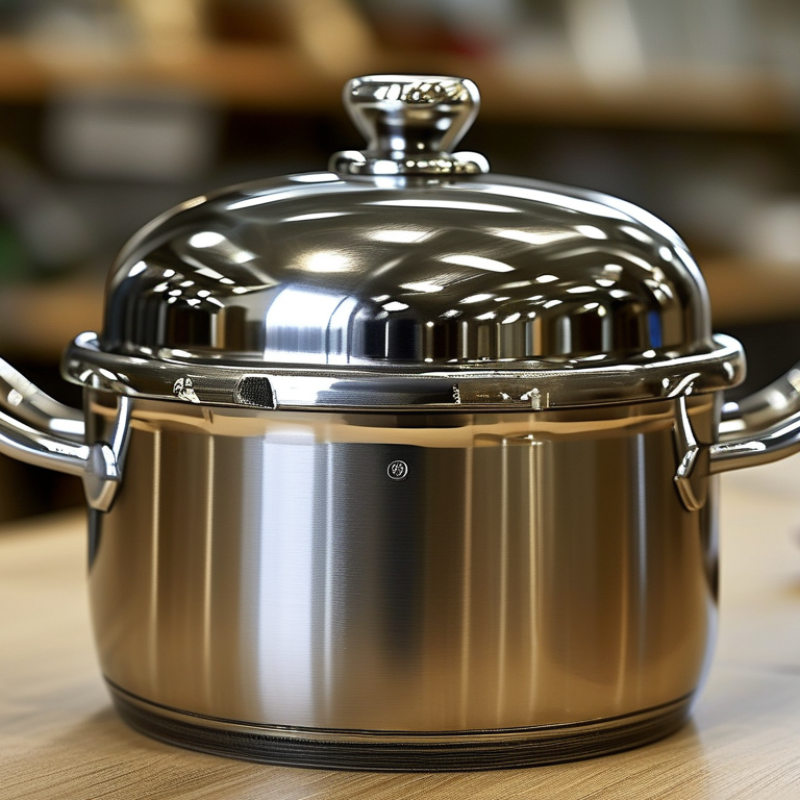
How to Choose a Stainless Steel Kitchenware Manufacturer?

Define Product Requirements: 304 vs. 316 Stainless Steel and 18/8 Grades

How to Choose a Stainless Steel Kitchenware Manufacturer?

Define Product Requirements: 304 vs. 316 Stainless Steel and 18/8 Grades

Before comparing manufacturers, define the kitchenware’s actual working conditions. Will it hold tomato sauce, sea salt, acidic dressings, or industrial detergent? These details matter more than a mirror-like finish. Grade 304 is commonly selected for pots, trays, bowls, and utensils. It contains roughly 18% chromium and 8% nickel, which explains the familiar 18/8 label. However, 18/8 describes composition, not a complete performance guarantee. Ask for the precise grade, thickness, and heat-treatment records.

Grade 316 adds molybdenum, improving resistance to chlorides and harsh, salty environments. It may suit coastal kitchens, brine contact, or frequent exposure to aggressive cleaners. It also costs more. That extra cost is not automatically justified for dry storage containers. A supplier should explain the choice using your cleaning cycle, temperature, and expected service life. Do not accept “food grade” as a complete technical answer. The phrase is too broad. Request material certificates, alloy verification, and surface-finish specifications.

During factory evaluation, inspect a cut edge, weld, and underside. These areas reveal burrs, contamination, weak polishing, or hidden corrosion risks. Ask whether 304 and 316 materials are stored separately. Traceability should reach the coil or sheet batch. A polished sample can mislead. I have seen attractive pieces fail because the alloy was never verified. That is an uncomfortable lesson, but it supports careful purchasing.

Verify Material Quality Through ASTM A240 and EN 10088 Compliance

How to Choose a Stainless Steel Kitchenware Manufacturer?

Material quality should begin with documented standards, not a shiny showroom sample. ASTM A240 covers stainless steel plate, sheet, and strip used in demanding applications. EN 10088 defines stainless steel grades, technical conditions, and key material properties. Ask the manufacturer which standard applies to each component.

Request the mill test certificate for every production batch. Check the heat number, steel grade, chemical composition, tensile strength, yield strength, and elongation. The certificate should match the markings on the delivered sheets. Traceability matters. Without it, even accurate-looking paperwork becomes difficult to trust.

Inspect the surface under strong, angled light. Look for scratches, pits, discoloration, uneven polishing, and rolled edges. Confirm thickness with a calibrated micrometer at several points. A kitchenware manufacturer should also explain how welding, forming, and cleaning affect corrosion resistance. ASTM A240 or EN 10088 compliance supports material verification, but it does not prove every finished product is safe or well made.

Ask for independent testing when records seem incomplete. A supplier may provide excellent documents yet control production poorly. That possibility deserves attention. I would also review corrective-action records and sample consistency, not only the best sample. Small inconsistencies can become large complaints after repeated washing, heating, and contact with food. Good manufacturers answer technical questions clearly and connect each product to a verifiable material history.

How to Choose a Stainless Steel Kitchenware Manufacturer?

Verify Material Quality Through ASTM A240 and EN 10088 Compliance

This chart compares the minimum specified chromium, nickel, and molybdenum content by mass for ASTM A240 Type 304 and 316L and their commonly corresponding EN 10088 grades 1.4301 and 1.4404. Values are based on published chemical composition ranges and are intended for initial supplier screening. Final verification should include the applicable standard edition, grade, product form, mill test certificate, and laboratory testing.

Assess Factory Capability Using ISO 9001, HACCP, and Production Capacity

How to Choose a Stainless Steel Kitchenware Manufacturer?

A factory’s certificate folder is only the starting point. Ask to see current ISO 9001 records, not just a wall certificate. The quality system should cover purchasing, forming, welding, polishing, inspection, and corrective actions. During a factory visit, compare written procedures with actual work. Are gauges calibrated? Are rejected pans clearly separated? Small details often reveal management discipline. I have found that clean records matter more than impressive machinery.

HACCP shows whether the manufacturer controls hazards linked to food-contact products. Review its hazard analysis, sanitation schedule, allergen controls, and traceability process. Ask how workers handle metal dust, lubricants, and packaging materials. A practical test is simple: request the batch code for a sample pan and follow it back to raw material records. If answers become vague, pause. A certificate cannot repair weak daily habits.

Production capacity needs evidence, too. Check the number of stamping presses, welding stations, polishing lines, and trained operators. Then compare monthly output with your forecast, including peak-season orders. Ask for recent lead-time data, not optimistic promises. A factory may produce ten thousand pieces monthly, yet one polishing bottleneck can delay everything. Review sample approval, maintenance plans, backup equipment, and inspection staffing. I would also place a small trial order before committing to large volumes. It may feel slower, but it exposes defects, communication gaps, and capacity assumptions early.

How to Choose a Stainless Steel Kitchenware Manufacturer? — Assess Factory Capability Using ISO 9001, HACCP, and Production Capacity
Assessment Area Key Metric Reference Requirement or Benchmark Evidence to Request Assessment Interpretation
Quality Management ISO 9001 certification status Certification should be valid, issued by an accredited certification body, and cover the factory location and relevant manufacturing activities. Current certificate, certification scope, expiry date, audit history, and certificate-verification record. Strong capability when the certificate scope covers stainless steel kitchenware production and the site being audited.
Quality Management Documented process controls Documented procedures should cover incoming inspection, production controls, final inspection, nonconforming products, corrective action, and record retention. Quality manual, inspection procedures, sample inspection records, corrective-action reports, and internal-audit records. A complete document trail indicates a repeatable quality system rather than inspection performed only at shipment.
Food Safety HACCP program HACCP should identify biological, chemical, and physical hazards and define critical control points, monitoring methods, limits, and corrective actions. HACCP plan, hazard analysis, process flow chart, monitoring logs, verification records, and employee training records. The program should be specific to the factory’s processes and products, not a generic template.
Food Safety Material and surface safety Food-contact materials should meet the legal and customer requirements of the destination market. Product surfaces should be free from rust, sharp edges, residues, and visible contamination. Material certificates, food-contact test reports, surface-finish specifications, cleaning records, and finished-product inspection reports. Lower risk is indicated by traceable material documentation and documented food-contact testing.
Raw Materials Stainless steel grade control Common food-contact grades include 304 and 316 stainless steel; the selected grade must match the product design, environment, and customer specification. Purchase records, supplier certificates, heat numbers, grade-verification reports, and material traceability records. Positive material identification and batch traceability reduce the risk of grade substitution.
Production Capacity Monthly finished-unit capacity Capacity should be stated by product type and process. A practical reference range for a medium-size facility is approximately 100,000–500,000 finished units per month, depending on complexity and automation. Capacity statement, production plans, recent output records, machine list, shift schedule, and utilization data. Capacity figures are credible only when supported by equipment, labor, operating hours, and recent production records.
Production Capacity Order fulfillment capacity The factory should demonstrate available capacity for the expected order volume while maintaining normal quality and lead-time performance. Three- to six-month production schedule, current utilization rate, open-order report, and peak-season capacity plan. A factory operating below approximately 80% planned utilization generally has more flexibility for new programs, subject to verification.
Manufacturing Equipment Core process coverage Equipment should match the required processes, such as blanking, deep drawing, forming, welding, polishing, cleaning, inspection, and packaging. Equipment inventory, machine specifications, maintenance records, calibration certificates, and production-line photographs or audit access. In-house control of critical processes can improve consistency, lead time, and engineering responsiveness.
Process Performance First-pass yield First-pass yield should be tracked by process and product. A reference target of 95% or higher is generally favorable for stable, repeat production, although product complexity affects the result. Monthly yield reports, defect Pareto charts, rework records, scrap records, and corrective-action trends. Consistent yield data over several months is more meaningful than a single inspection result.
Inspection Capability Inspection and testing resources The facility should have calibrated tools and defined inspection methods for dimensions, thickness, surface finish, weld quality, leakage where applicable, and packaging condition. Inspection plan, sampling standard, calibration records, test-equipment list, and completed inspection reports. Independent or third-party testing may be added for regulated food-contact, coating, or performance requirements.
Traceability Batch and lot identification Raw materials, work-in-process, finished goods, and shipment records should be linked through batch or lot identification. Lot-code procedure, material-to-product traceability sample, production records, and recall or mock-recall results. Traceability supports faster investigation and targeted corrective action when a defect is identified.
Delivery Reliability On-time delivery performance A supplier should track confirmed-date performance. An on-time delivery rate of 95% or higher is a useful reference benchmark for established programs. Recent delivery-performance report, production schedule, shipment records, and explanation of late-order causes. Review performance during peak periods, material shortages, and new-product launches rather than relying only on annual averages.
Supplier Decision Recommended qualification outcome Approve only when certification validity, HACCP implementation, material traceability, production capacity, and inspection records are all verified. Completed factory-audit checklist, corrective-action closure evidence, approved sample, test reports, and signed technical specifications. Use conditional approval when gaps are documented with deadlines, owners, and follow-up verification.
Note: The capacity and performance figures above are practical reference benchmarks for supplier evaluation, not data from any specific company or brand. Final acceptance should be based on an on-site audit, current records, approved samples, and destination-market requirements.

Compare Testing Standards, Including FDA, LFGB, and 0.5% Nickel Limits

Choosing a stainless steel kitchenware manufacturer requires more than checking surface finish or product price. Testing standards deserve closer attention.

Ask whether the supplier tests food-contact safety under FDA requirements and LFGB principles.

FDA compliance usually depends on the intended food-contact use, manufacturing controls, and supporting test evidence. It is not always a single approval for every steel product. LFGB evaluation may include migration testing, sensory checks, and material safety assessment. Request the exact test method, product model, test date, and laboratory details.

The 0.5% nickel limit needs careful interpretation.

Does it describe total nickel in the alloy, or nickel released into food? These are different measurements. A handheld alloy scan can verify composition, but it cannot replace migration testing. Ask for both when nickel exposure matters.

Test conditions should reflect acidic foods, salt, heat, and repeated washing. Small details matter.

Choose a manufacturer that provides batch traceability and reports from an ISO/IEC 17025-accredited laboratory. Check whether the tested sample matches your actual cookware.

A certificate alone can still mislead. One practical mistake is trusting a general report for a different steel grade. It sounds simple, but it is not.

Review the raw material grade, surface treatment, weld areas, and production controls before placing a large order.

Evaluate MOQ, Lead Times, Pricing, Warranty, and Export Experience

Choosing a stainless steel kitchenware manufacturer starts with MOQ, but MOQ is a cash-flow decision, not merely a factory rule. A low MOQ reduces inventory risk, while a higher MOQ may cut unit costs and lock up working capital. Request prices for 500, 1,000, and 5,000 pieces. Specify steel grade, thickness, polishing, packaging, tooling, and inspection fees. The cheapest quote is rarely complete.

Lead times need separate production and shipping estimates. UNCTAD’s Review of Maritime Transport 2024 states that maritime transport carries over 80% of global merchandise trade by volume. Port congestion can therefore affect an otherwise capable supplier. Ask for a production schedule, shipping method, and delay procedure. Ask for evidence. A promised seven-day production time deserves careful verification when custom molds are involved.

Warranty terms should identify coverage, exclusions, claim evidence, and replacement timing. “Quality guaranteed” is too vague. Export experience also requires proof, such as redacted shipping documents, destination markets, and customs-handling experience. The World Bank’s Logistics Performance Index 2023 evaluates customs, infrastructure, shipment quality, and timeliness; use these areas when interviewing suppliers. Pricing should include Incoterms, currency risks, freight, duties, and payment stages. Do not guess. One practical weakness is relying on a polished sample; production batches can differ. Approve a pre-shipment inspection and record measurable tolerances before payment.

FAQS

Which material standards should a stainless steel kitchenware manufacturer follow?

Ask whether each component follows ASTM A240 or EN 10088 requirements. The answer should match the product’s steel grade, thickness, and intended use. A shiny sample proves very little. Request documented evidence for every batch.

What should I check on a mill test certificate?

Check the heat number, steel grade, chemical composition, tensile strength, yield strength, and elongation. The certificate must match markings on the delivered sheets. Traceability matters. Without matching records, reliable verification becomes difficult.

How can I inspect stainless steel surface quality?

Use strong, angled light during inspection. Look for scratches, pits, discoloration, uneven polishing, and rolled edges. Measure thickness with a calibrated micrometer at several points. One measurement is not enough.

Do material certificates prove finished-product quality?

No. They mainly support material verification. Finished quality also depends on forming, welding, polishing, cleaning, and inspection. Ask how these processes affect corrosion resistance. I would request independent testing when records seem incomplete.

How can I evaluate a factory’s quality management system?

Request current ISO 9001 records and review actual production practices. Check purchasing, forming, welding, polishing, inspection, and corrective actions. During a visit, inspect calibration records and rejected-product areas. Clean records matter. Machines alone are not enough.

How does HACCP help with kitchenware manufacturing?

HACCP helps control hazards related to food-contact products. Review hazard analysis, sanitation schedules, allergen controls, and traceability procedures. Ask how workers handle metal dust, lubricants, and packaging materials. Follow one batch code back to its raw material records. Vague answers deserve caution.

How should I assess production capacity and lead times?

Count stamping presses, welding stations, polishing lines, and trained operators. Compare reported monthly output with your forecast and peak-season demand. Ask for recent lead-time data, not only promises. A polishing bottleneck can delay thousands of finished pieces. Capacity estimates can be wrong.

What should I clarify about MOQ, pricing, warranty, and export experience?

Request prices for 500, 1,000, and 5,000 pieces. Specify steel grade, thickness, polishing, packaging, tooling, and inspection fees. Separate production time from shipping time. Confirm Incoterms, freight, duties, currency risks, and payment stages. Warranty terms should define coverage, exclusions, evidence, and replacement timing. Approve a pre-shipment inspection before making final payment.

Conclusion

Choosing the right partner for Stainless Steel Kitchenware Manufacturing requires a clear evaluation of both product specifications and factory reliability. Start by defining whether 304 or 316 stainless steel is suitable for your products, and confirm whether an 18/8 grade is required for food-contact applications. Material quality should be supported by documentation demonstrating compliance with ASTM A240 and EN 10088. It is also important to assess the factory’s ISO 9001 quality system, HACCP practices, equipment, workforce, and production capacity.

Before making a decision, compare testing requirements such as FDA, LFGB, and applicable 0.5% nickel limits, ensuring that test reports are current and traceable. Finally, review minimum order quantities, lead times, pricing structure, warranty terms, packaging capabilities, and previous export experience. A dependable manufacturer should communicate clearly, provide consistent quality control, and offer practical support from sampling through mass production.

Olivia Carter

Olivia Carter

Olivia Carter is a highly accomplished marketing professional dedicated to helping businesses communicate their value with clarity, confidence, and purpose. With extensive experience in market research, content strategy, customer engagement, and digital communications, she brings both strategic......