The global cookware industry is becoming more competitive, transparent, and quality-conscious. Fortune Business Insights estimates that the global cookware market was valued at approximately USD 19.77 billion in 2023. Its growth reflects rising household demand, professional kitchens, and replacement purchases. Stainless steel remains important because it offers durability, heat resistance, and a clean appearance. However, not every polished product represents the same manufacturing standard.
Wholesale Stainless Steel Cookware buyers need evidence, not attractive catalogues alone. World Stainless reported global crude stainless steel production of about 58.4 million tonnes in 2023. This scale supports broad material availability, but it also makes supplier evaluation more complex. A reliable factory should explain its steel grades clearly, including 304 or 18/10 stainless steel where appropriate. Buyers should also inspect welding points, rim finishing, handle stability, base construction, and food-contact documentation. Small details matter. A loose handle can damage an entire product line.
This guide reviews Top Wholesale Stainless Steel Cookware Suppliers Worldwide through practical sourcing criteria. These include production experience, minimum order quantities, private-label capability, quality-control systems, export history, and delivery performance. Certifications may support trust, but they do not replace factory audits or sample testing. That is an important limitation. Supplier websites can become outdated, and reported capacities may not reflect current workloads. Therefore, procurement teams should request recent test reports, production photographs, sample units, and traceable company information before signing contracts. The strongest supplier is not always the largest. It is the one that consistently delivers safe, durable cookware with clear communication and measurable accountability.
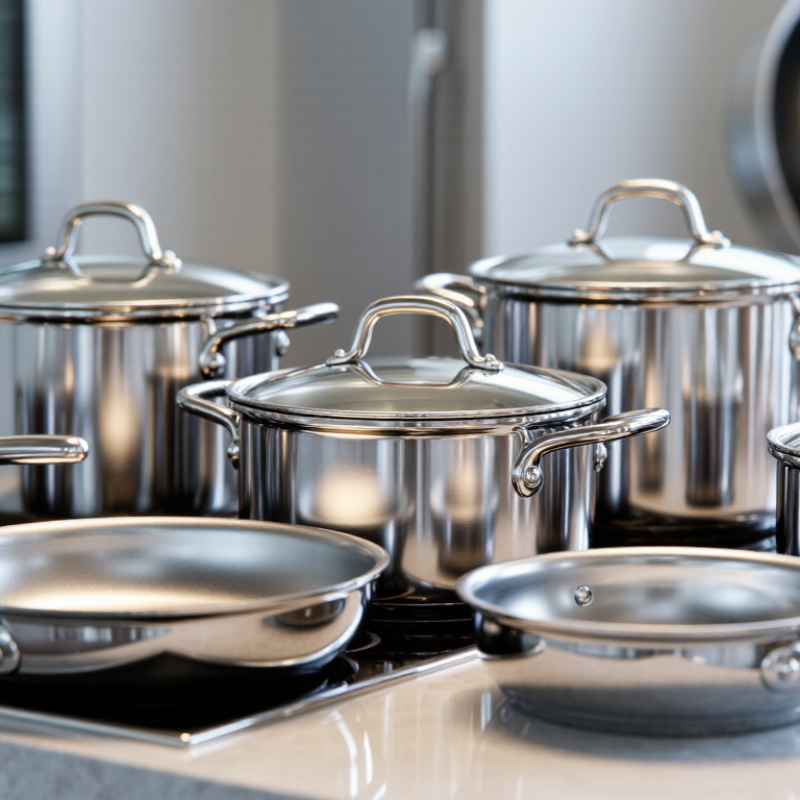
What Defines a Top Wholesale Stainless Steel Cookware Supplier
A top supplier offers more than polished pots and competitive quotations. It provides verifiable material information, stable production, and practical after-sales support. The World Stainless Association reported approximately 58.4 million tonnes of crude stainless steel production in 2023. This scale makes material traceability especially important. Buyers should request heat numbers, mill certificates, and clear grade specifications for every shipment.
Performance must be tested, not assumed. A capable supplier should provide samples with measured wall thickness, base flatness, handle strength, and heat distribution results. Food-contact documentation should match the destination market. ISO 8442-1 and relevant food-contact requirements offer useful reference points, although compliance documents alone cannot prove everyday durability. Ask for independent test reports when possible. Small details matter.
Reliable suppliers also control variation between batches. Their inspection records should show checks for welding, polishing, lid fit, and packaging damage. The global cookware market was valued at about USD 19 billion in 2023, according to Grand View Research, reflecting strong demand but also intense competition. Price alone is not proof. A low quotation may hide thinner steel, weaker handles, or inconsistent polishing. In sourcing work, response speed is another practical signal. Can the supplier explain a failed sample without avoiding the question? No supplier is perfect. Even strong factories may need clearer inspection rules, better packaging tests, or more frequent communication.
| Evaluation Dimension | What a Top Wholesale Supplier Should Demonstrate | Practical Benchmark | Recommended Verification Evidence |
|---|---|---|---|
| Stainless Steel Grade | Clear material specifications for the cooking surface, body, handles, lids, and any bonded layers. | Food-contact cooking surfaces commonly use 18/10 or 18/8 stainless steel, generally corresponding to 304-series stainless steel. | Material certificates, mill test reports, grade declarations, and independent alloy-composition testing. |
| Food-Contact Safety | Products are designed and tested for food-contact use in the intended sales markets. | Documentation should address applicable requirements such as EU food-contact framework rules, U.S. food-contact regulations, or equivalent national standards. | Third-party migration reports, food-contact declarations, test methods, laboratory accreditation, and product traceability records. |
| Construction Quality | Consistent wall thickness, secure handles, smooth rims, stable bases, and uniform welding or riveting. | Multi-layer or impact-bonded bases should be specified by layer composition, thickness, diameter, and bonding method rather than described only as “premium.” | Technical drawings, cross-section samples, dimensional inspection reports, and production-line quality records. |
| Heat Distribution | Cookware provides stable heating performance and minimizes hot spots during normal use. | Aluminum or copper heat-spreading layers may be used in bonded bases; performance should be confirmed through controlled heating tests. | Thermal distribution test results, heating-cycle records, base-construction details, and sample evaluation under the target cooktop type. |
| Cooktop Compatibility | Product specifications clearly identify compatibility with gas, electric, ceramic, and induction cooktops. | For induction use, the base must contain a suitable magnetic layer and pass induction-heating testing; compatibility should not be assumed from stainless steel content alone. | Induction test records, product markings, user instructions, and test samples for each cookware series. |
| Quality-Control System | Documented incoming-material inspection, in-process controls, final inspection, and corrective-action procedures. | A mature supplier normally operates a formal quality-management system, such as ISO 9001, supported by batch-level inspection records. | Valid quality-system certificates, inspection plans, defect classification standards, audit reports, and corrective-action logs. |
| Order Flexibility | Ability to support standard collections, private-label programs, custom packaging, and approved product modifications. | Minimum order quantities, sample fees, tooling charges, and customization limits should be stated in writing before quotation approval. | Official quotation, specification sheet, sample approval form, packaging artwork process, and written change-control procedure. |
| Production Capacity | Capacity is supported by equipment, labor planning, raw-material availability, and realistic scheduling. | Capacity should be expressed as monthly units by product category, with separate figures for standard and customized orders. | Capacity statement, production schedule, facility audit, equipment list, and historical on-time delivery data. |
| Lead-Time Reliability | Quoted lead times include approval, production, inspection, packaging, and shipment preparation stages. | For established standard items, a typical production estimate may be approximately 30–60 days after specifications and deposit are confirmed; custom programs may require longer. | Written production timeline, order milestones, shipment records, and service-level or delay-escalation terms. |
| Durability Testing | Products are evaluated for corrosion resistance, handle strength, lid fit, dishwasher exposure, and repeated heating and cooling. | Testing should reflect the intended product claims and local usage conditions rather than relying only on visual inspection. | Test protocols, laboratory reports, retained samples, cycle-test results, and warranty or complaint statistics. |
| Dimensional Consistency | Diameter, capacity, height, wall thickness, base flatness, and lid fit remain within agreed tolerances. | Each SKU should have approved drawings and measurable acceptance tolerances before mass production begins. | Approved technical drawings, first-article inspection reports, calibrated measuring-equipment records, and batch inspection data. |
| Packaging Protection | Packaging prevents scratches, dents, moisture damage, and movement during international transport. | Packaging should specify inner protection, carton strength, carton dimensions, gross weight, net weight, and pallet configuration where applicable. | Packaging specification, drop-test results, carton inspection records, loading photographs, and shipping marks. |
| Export Documentation | Supplier can prepare consistent commercial and regulatory documents for international wholesale shipments. | Standard documentation typically includes commercial invoice, packing list, shipping document, product specification, and origin information when required. | Sample document set, tariff classification support, country-of-origin statement, and export compliance process. |
| Traceability | Finished products can be linked to raw materials, production batches, inspection results, and shipment records. | Batch or lot identification should remain available from production through delivery and after-sales support. | Lot-code system, batch records, material-to-product tracking, retention-sample policy, and recall procedure. |
| Commercial Transparency | Pricing, tooling, samples, payment terms, warranty scope, replacement policy, and shipping responsibilities are clearly defined. | A complete quotation should separate product cost, packaging, tooling, inspection, freight, taxes, and other applicable charges. | Signed quotation, sales contract, pro forma invoice, warranty terms, and documented claim-resolution process. |
The supplier should state the steel grade, thickness tolerance, and batch details.
Samples reveal heat distribution, wall thickness, balance, and handle strength.
Check welding, polishing, rivets, surface marks, lid alignment, and base flatness.
Request recent inspection records and corrective-action evidence.
Review worker training, inspection checkpoints, storage conditions, and packing procedures.
Ask for current food-contact documents and independent test reports.
Compare previous lead times, container loading plans, moisture protection, and export documents.
Not necessarily. A low price may reflect thinner steel, weaker handles, or poor packaging.
A trial order compares actual delivery with promised quality, timing, and packaging.
Choosing a top Wholesale Stainless Steel Cookware supplier requires more than comparing product prices. Reliable suppliers are defined by consistent manufacturing standards, durable materials, transparent communication, dependable production capacity, and the ability to support different business needs. When evaluating global cookware suppliers, buyers should consider stainless steel grade, construction quality, heat performance, product range, order flexibility, packaging, delivery reliability, and customer service. Certifications and quality-control procedures are also important indicators of responsible and professional operations.
Wholesale stainless steel cookware suppliers may include manufacturers, specialized distributors, custom production partners, and export-oriented companies. Businesses should compare product quality, pricing structure, minimum order quantities, certifications, warranty policies, customization options, and after-sales support before making a decision. A practical selection process includes defining target customers, requesting samples, reviewing supplier documentation, confirming production and shipping capabilities, and negotiating clear terms. By evaluating these factors carefully, businesses can build a stable supply chain and select a supplier that offers long-term value, consistent quality, and dependable service.