
0%

Choosing the right Professional Catering Utensils can shape every stage of a food service operation. A busy kitchen depends on tools that support speed, safety, consistency, and clean presentation. From stainless steel tongs and portion scoops to chef knives, ladles, whisks, and heat-resistant spatulas, each utensil has a practical role. A reliable tool should feel balanced, withstand repeated washing, and perform well during peak service.

Professional caterers often judge utensils through daily experience. A narrow serving spoon may reach deep trays more effectively, while strong tongs can lift roasted vegetables without crushing them. Silicone handles may improve grip near hot pans, but they can still wear when exposed to excessive heat. Stainless steel is durable and easy to sanitize, although cheaper grades may stain or bend. These details matter when staff work quickly beside steaming ovens and crowded preparation tables.

This guide examines the top utensil categories used in professional catering. It considers material quality, ergonomic design, hygiene, storage, and long-term value. Not every expensive utensil is superior. That assumption deserves attention. The best choice depends on menu style, service volume, washing systems, and staff habits. Readers will find practical comparisons rather than exaggerated claims. Some recommendations may also require adjustment, because real kitchens reveal weaknesses that product descriptions often overlook. Good equipment should make service smoother, not create another problem during a demanding event.
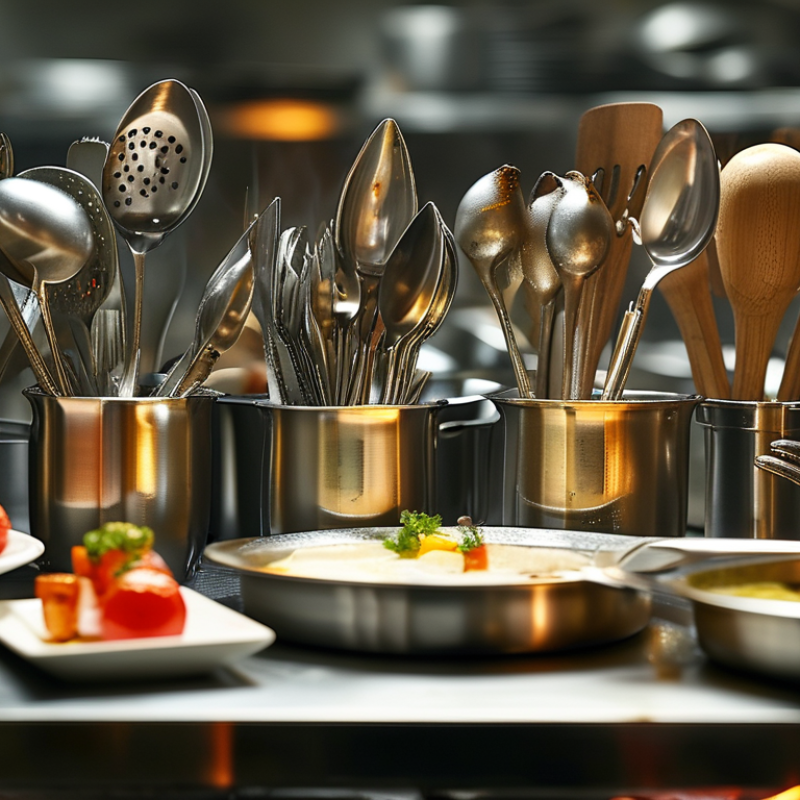
What Are the Top Professional Catering Utensils?

Defining Professional Catering Utensils and Their Essential Functions

Professional catering utensils are tools designed for repeated, demanding work in commercial food preparation. They support preparation, cooking, portioning, serving, and sanitation. Unlike ordinary kitchen tools, they must handle speed, heat, moisture, and frequent cleaning. A sturdy chef’s knife supports accurate cutting and reduces hand strain. Heat-resistant tongs move delicate food without crushing it. Small details matter.

Each utensil has an essential function during service. Ladles help control soup portions and reduce waste. Spatulas turn food and scrape pans clean. Whisks blend sauces, eggs, and dressings smoothly. Food thermometers check internal temperatures more reliably than appearance alone. Serving spoons help staff deliver consistent portions. This consistency protects quality, especially when many guests receive the same dish.

From practical kitchen experience, comfort and balance can matter as much as durability. A heavy utensil may feel dependable, but it can tire a cook during a long shift. I have also found that narrow handles sometimes become slippery with wet gloves. That detail is easy to overlook. No utensil replaces proper technique or careful cleaning. Tools should be washed, sanitized, dried, and inspected for cracks or loose parts. Sometimes the simplest spoon performs best, but only when it fits the task and the person using it.

What Are the Top Professional Catering Utensils?

Defining professional catering utensils and their essential functions

Professional catering utensils are selected for portion control, speed, hygiene, and consistent service. The chart compares common nominal capacities: a portion scoop is typically about 60 mL, a serving spoon about 30 mL, a ladle about 120 mL, a measuring cup about 237 mL, and a squeeze bottle about 355 mL. Actual capacities can vary by utensil design and operating standard.

Classifying Utensils by Food Preparation and Service Tasks

What Are the Top Professional Catering Utensils?

Professional catering utensils work best when classified by preparation and service tasks. Cutting requires chef’s knives, paring knives, peelers, and sturdy cutting boards. Mixing needs stainless-steel bowls, whisks, spatulas, and portioning scoops. For hot preparation, cooks depend on ladles, tongs, turners, probes, and heat-resistant gloves.

Each tool should match the food, temperature, and workload. A narrow spatula can lift delicate pastries, while a slotted turner handles fried items with less oil. Deep ladles suit soups and sauces. Portion scoops improve consistency during high-volume service. According to the National Restaurant Association’s 2024 State of the Restaurant Industry Report, U.S. restaurant sales were projected to reach $1 trillion, increasing pressure on speed and portion control. That pressure changes utensil selection. Small details matter.

Serving tasks require another classification. Tongs support salads and grilled foods. Serving spoons handle grains, vegetables, and sauces. Cake servers protect presentation. Separate utensils also help reduce cross-contact risks. The FDA Food Code 2022 emphasizes hygienic handling and proper utensil storage, especially during continuous food service. In practice, clean handles and dedicated tools are often overlooked. I have seen teams choose oversized utensils because they feel faster. They are not always faster. Heavy tools can increase fatigue, spills, and inconsistent portions. A better system labels utensils by task, stores them near the workstation, and reviews performance after busy shifts. Some choices will still need revision.

Evaluating Materials, Durability, Safety, and Ergonomic Design

Professional catering utensils must survive heat, pressure, repeated washing, and constant handling. Material choice controls much of that performance. Stainless steel offers strong corrosion resistance and a clean, nonporous surface. It also tolerates commercial dishwashers better than many softer metals. Silicone handles can reduce heat transfer, but they must remain stable near cooking temperatures. Plastic tools should be clearly rated for food contact and tested for cracking or discoloration. Grip matters.

Durability is not only about thickness. A heavy ladle may last longer, yet fatigue workers during a busy service. I once preferred thick serving tongs, then noticed wrist strain after several hours. That experience changed my view of “professional” quality. Balanced weight, smooth joints, and rounded edges often matter more than impressive size. Handles should fit different hand sizes without forcing tight pressure. Textured surfaces help with wet gloves, although deep grooves can trap food residue.

Safety requires practical inspection. Look for seamless construction, secure rivets, and surfaces without flaking coatings. Utensils should resist bending during normal use and remain stable when placed beside hot pans. Heat-resistant materials reduce burns, but no label replaces careful temperature judgment. Ergonomic design also needs honest testing. A handle may feel comfortable for five minutes, then become tiring during a long banquet. Cleaning access, storage space, and quick visual checks deserve attention too. Small flaws become expensive during service.

Identifying Essential Utensils for Different Catering Operations

What Are the Top Professional Catering Utensils?

Identifying Essential Utensils for Different Catering Operations

Professional catering utensils should match the service style, menu, and working space. In my experience, a reliable chef’s knife, cutting board, tongs, ladles, and heat-resistant spatulas support most food preparation tasks. For plated dinners, offset spatulas and precision tweezers help control portions and presentation. Buffet operations need deep serving spoons, sturdy turners, soup ladles, and insulated containers that protect food temperatures during service.

Mobile catering requires lighter, stackable tools because storage space is limited. A compact whisk, measuring set, squeeze bottles, and folding colander can prevent unnecessary movement. High-volume kitchens need stronger equipment, such as stainless-steel mixing bowls, portion scoops, and long-handled utensils. These tools improve consistency and reduce contact with hot surfaces. Still, durability alone is not enough. I once chose oversized tongs for a crowded service line, and they slowed every plate. The mistake was small but costly.

Tips: Match each utensil to one task. Label tools for allergen-sensitive preparation. Keep spare tongs and ladles nearby. Clean handles often, especially during buffet service. Test grip comfort before buying large quantities. A utensil may look professional but feel awkward after two hours. Check heat resistance, balance, storage needs, and cleaning requirements. Review the setup after each event; real service reveals problems that product descriptions often miss.

What Are the Top Professional Catering Utensils? - Identifying Essential Utensils for Different Catering Operations

Utensil Primary Catering Operation Main Function Recommended Material Typical Capacity or Size Key Performance Requirement Cleaning and Safety Considerations Priority
Serving Spoon Buffet Service Portioning vegetables, rice, sauces, side dishes, and other prepared foods. Stainless steel or heat-resistant food-grade plastic Approximately 60–120 ml bowl capacity Comfortable handle, smooth bowl, and resistance to heat and corrosion. Wash and sanitize after use; avoid handles that trap food or moisture. Essential
Slotted Serving Spoon Buffet Service Lifting solid foods while allowing excess liquid or oil to drain away. Stainless steel Approximately 25–35 cm overall length Evenly spaced slots and a rigid bowl for controlled serving. Inspect slots for residue; clean thoroughly to prevent cross-contamination. High
Serving Fork Buffet Service Handling roasted meats, pasta, vegetables, and other firm foods. Stainless steel Approximately 25–35 cm overall length Strong, smoothly finished tines and a balanced handle. Clean between different food types, especially raw and ready-to-eat foods. Essential
Serving Tongs Buffet and Plated Service Picking up salads, pastries, meats, vegetables, and other foods without direct hand contact. Stainless steel or food-grade silicone-tipped stainless steel Approximately 23–30 cm overall length Secure grip, smooth spring action, and sufficient reach for deep pans. Disassemble or open fully during washing; keep handles away from food-contact surfaces. Essential
Ladle Soup and Sauce Service Serving soups, gravies, sauces, stews, and liquid-based foods. Stainless steel or heat-resistant food-grade plastic Approximately 60–240 ml bowl capacity Clearly defined bowl volume, long handle, and heat resistance. Sanitize after each service period; store so the bowl does not contact unclean surfaces. Essential
Turner or Spatula Hot Food Production Turning, lifting, and transferring foods from griddles, trays, and pans. Stainless steel or heat-resistant nylon Blade width commonly 7–15 cm Thin leading edge, strong blade, and a handle rated for the intended heat. Use only on compatible cookware surfaces; remove from service if cracked or warped. High
Whisk Sauce and Pastry Preparation Blending sauces, dressings, batters, eggs, and cream-based mixtures. Stainless steel Approximately 20–35 cm overall length Evenly spaced wires, firm attachment, and a comfortable non-slip grip. Clean between allergen-containing and allergen-free preparations; dry completely. High
Chef’s Knife Food Preparation Chopping, slicing, mincing, and portioning a wide range of ingredients. Corrosion-resistant stainless steel with a durable food-safe handle Blade length commonly 20–25 cm Sharp, stable blade and ergonomic handle that supports controlled cutting. Hand-wash when required by the manufacturer; store in a rack or protective holder. Essential
Paring Knife Garnish and Detail Preparation Peeling, trimming, shaping, and performing small precision cuts. Corrosion-resistant stainless steel Blade length commonly 7–10 cm Fine sharp edge and precise point control. Use a designated storage location; sanitize after preparing produce or allergen-containing foods. Medium
Cutting Board Food Preparation Providing a stable, hygienic surface for cutting and portioning ingredients. Commercial food-grade plastic or sealed hardwood approved for food contact Commonly 45–60 cm long for prep stations Non-slip stability, sufficient thickness, and a surface free from deep grooves. Use separate or color-coded boards for raw proteins and ready-to-eat foods; replace when heavily scored. Essential
Measuring Cup and Spoon Set Recipe Production Measuring liquid and dry ingredients consistently across batches. Stainless steel or food-grade plastic Common spoon sizes range from 1.25–15 ml; cups vary by recipe system Clear volume markings and stable, repeatable measurements. Clean and dry between ingredients; verify markings remain legible. High
Digital Probe Thermometer Food Safety Control Checking internal temperatures during cooking, holding, cooling, and reheating. Stainless steel probe with a food-safe digital housing Typical measurement range is approximately −50°C to 300°C, depending on model Fast response, readable display, and regular calibration checks. Clean and sanitize the probe before and after each measurement; prevent contact between raw and cooked foods. Essential
Food Pan Serving Utensil Chafing and Hot Holding Serving food from hotel pans, chafers, and other large holding containers. Stainless steel or heat-resistant food-grade plastic Approximately 30–40 cm overall length for deep pans Long reach, heat resistance, and a handle that remains easy to grip. Keep handles outside food pans where possible; clean and sanitize between menu items. Essential
Pastry Brush Baking and Finishing Applying glazes, butter, oil, sauces, and egg wash to food surfaces. Food-grade silicone or heat-resistant synthetic bristles Brush width commonly 2.5–5 cm Secure bristles, even application, and heat resistance when used near ovens. Clean between ingredients; silicone designs reduce loose-bristle risk. Medium
Can Opener Bulk Food Preparation Opening canned ingredients used in large-volume food production. Stainless steel cutting components with a food-safe handle Manual countertop models commonly accommodate standard commercial cans Stable operation, clean cutting action, and resistance to corrosion. Clean the cutting wheel and shaft thoroughly; remove from service if metal fragments appear. Medium

Choosing the Right Utensils for Efficiency, Hygiene, and Budget

What Are the Top Professional Catering Utensils?

In a busy catering kitchen, the right utensils reduce wasted motion and service delays. A sharp chef’s knife, heat-resistant tongs, solid ladles, and flexible spatulas form a practical core. Choose balanced handles that stay comfortable during long preparation periods. Small details matter. A ladle with clear volume markings improves portion control and reduces food waste. Stainless steel often suits heavy use, while silicone tools protect coated cookware from scratches.

Hygiene must guide every purchase. Select smooth, non-porous surfaces with no deep seams or trapped-food areas. Separate cutting boards by food type, and use clear color coding. Utensils should tolerate the kitchen’s approved cleaning process without cracking or warping. I once overlooked a narrow joint on a serving spoon. It collected residue and required extra scrubbing every evening. That mistake changed my buying checklist.

Budget decisions need a useful order of priority. Spend more on knives, tongs, and tools used continuously. Choose simpler pieces for occasional service tasks. Buy replacement parts only when they are available and reasonably priced. Cheap utensils may bend during a crowded dinner service, creating safety and timing problems. Still, expensive does not always mean efficient. Test grip, weight, cleaning time, and storage fit before buying in bulk. A short trial with real staff often reveals problems that product descriptions miss.

FAQS

What are professional catering utensils?

They are tools built for repeated work in commercial food preparation. They support cutting, cooking, portioning, serving, and sanitation. Small details matter.

Which utensils support most catering operations?

A chef’s knife, cutting board, tongs, ladles, and heat-resistant spatulas cover many basic tasks. Busy kitchens may also need mixing bowls, portion scoops, whisks, and long-handled tools. Choose tools by menu and service style.

Why are ladles and serving spoons important?

Ladles help control soup portions and reduce waste. Serving spoons provide more consistent portions across many guests. Consistency protects both quality and cost.

How should catering utensils be selected for buffet service?

Choose deep serving spoons, sturdy turners, soup ladles, and insulated containers. Keep spare tongs nearby. Clean handles often during service.

What materials work well for professional utensils?

Stainless steel resists corrosion and has a nonporous surface. Silicone handles can reduce heat transfer. Plastic tools should be rated for food contact. Inspect them for cracks or discoloration.

Does heavier equipment always mean better quality?

No. Heavy tools may last longer but can tire workers during long shifts. Balanced weight, smooth joints, and rounded edges may matter more. More thickness is not always better.

What ergonomic features should catering utensils have?

Handles should suit different hand sizes and avoid forcing tight pressure. Textured grips help with wet gloves. However, deep grooves may trap food residue. Comfort should be tested after several hours.

How can catering utensils be checked for safety?

Look for seamless construction, secure rivets, and surfaces without flaking coatings. Tools should resist normal bending and remain stable near hot pans. Heat resistance helps, but careful temperature judgment remains necessary.

How should catering utensils be cleaned and maintained?

Wash, sanitize, dry, and inspect every utensil regularly. Check for cracks, loose parts, trapped residue, and damaged handles. Cleaning access matters. I sometimes underestimated it.

How can a catering team choose the right tool size?

Match each utensil to one task and the available workspace. Mobile operations benefit from lighter, stackable tools. Crowded service lines need compact utensils. Oversized tongs can slow plating.

Conclusion

Professional Catering Utensils are essential tools designed to support efficient food preparation, cooking, serving, and cleanup in commercial catering environments. This category includes knives, cutting boards, mixing tools, measuring equipment, cookware, serving utensils, storage tools, and sanitation accessories. Each utensil should match its intended task, helping catering teams maintain accuracy, speed, consistency, and professional presentation during busy operations.

When selecting Professional Catering Utensils, caterers should evaluate material quality, durability, heat resistance, food safety, ease of cleaning, and ergonomic design. Stainless steel, food-grade silicone, and other reliable materials can provide long-term performance when properly maintained. Different catering operations may require different combinations of preparation and service tools, depending on menu size, kitchen layout, event scale, and staffing needs. Choosing the right utensils ultimately improves workflow, supports hygiene standards, reduces replacement costs, and ensures that the available budget is used effectively.

Ethan Carter

Ethan Carter

Ethan Carter is a dedicated marketing professional with a strong understanding of product strategy, customer needs, and market trends. As a valued member of our team, he combines analytical insight with clear, engaging communication to help readers better understand the solutions and services our......