Expert guides, trends, and knowledge on commercial stainless steel kitchenware manufacturing.
Discover tips and developments in high-quality daily kitchen tools and gadgets.
Industry standards and best practices for hotel and catering equipment buyers.
Choosing the right Custom Branded Kitchen Utensils requires more than adding a logo to a popular product. A useful utensil must perform reliably, feel comfortable, and represent a brand in daily use. This guide examines practical options, from silicone spatulas and wooden spoons to measuring cups, whisks, and serving tools. Each item offers a different balance of visibility, cost, durability, and cleaning convenience.
Material selection deserves careful attention. Food-contact surfaces should come from reputable suppliers with clear safety documentation. Stainless steel can provide strength and a polished appearance. Silicone often handles heat well, but its quality may vary between manufacturers. Bamboo and wood create a warm, natural impression, although they require thoughtful care and moisture control. Small details matter. A loose handle, shallow engraving, or fading print can quickly weaken a customer’s experience.
The strongest choice depends on the audience and the setting. A cooking school may value heat-resistant tools with clear measurement marks. A restaurant might prefer durable serving utensils that remain visible during busy service. A homeware brand could select coordinated sets with refined packaging. There is no universal winner. That assumption is too simple.
Professional evaluation should include grip comfort, edge quality, wash performance, packaging protection, and branding accuracy. Samples should be tested before a larger order is approved. Even then, testing may miss real-world problems, such as staining from tomato sauce or awkward storage in a crowded drawer. Reviewing those weaknesses builds trust and improves the final selection. This article compares leading options and explains where each Custom Branded Kitchen Utensils category performs best.
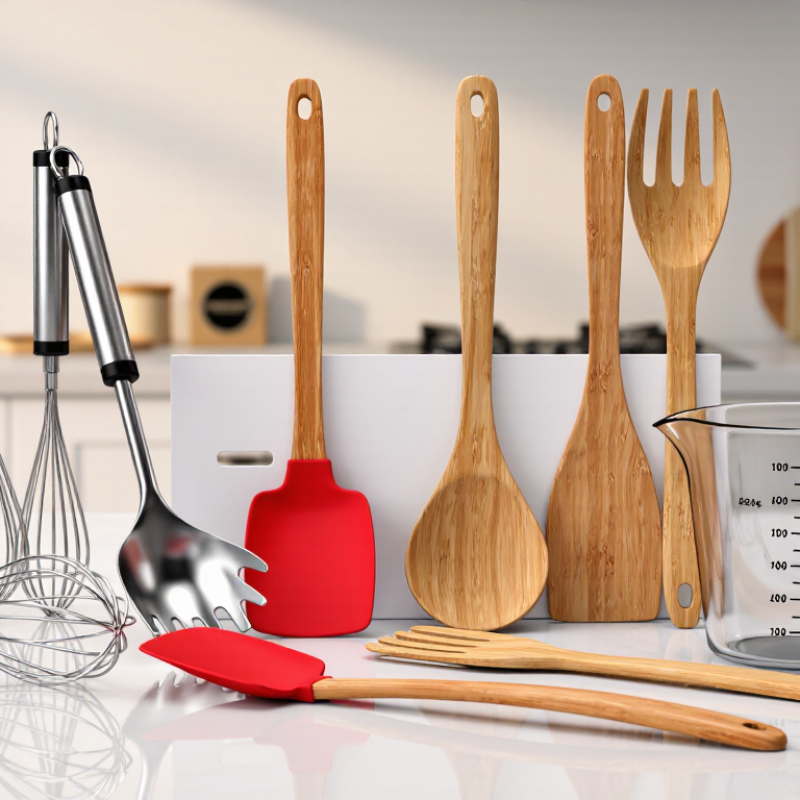
Custom branded kitchen utensils are practical cooking tools personalized with a company name, logo, message, or chosen colors. Common examples include spatulas, wooden spoons, measuring cups, tongs, aprons, and cutting boards. The branding may be printed, engraved, embossed, or molded into the handle.
These utensils serve several everyday purposes. Cafés can use branded measuring spoons behind the counter, while catering teams may display personalized serving tools at food events. Companies also give them as employee gifts, customer rewards, or welcome items for cooking classes. A useful utensil stays visible in the kitchen. That repeated exposure can create stronger brand recognition than a paper advertisement.
Material and design require careful review. Stainless steel handles usually offer durability, while food-grade silicone can resist heat and protect coated cookware. Wooden tools feel warm and natural, but they need proper drying after washing. Check heat limits, cleaning instructions, and food-contact documentation before ordering. Small details matter. A logo placed near the grip may fade faster from frequent washing. I once underestimated handle thickness when comparing samples, and the tool felt awkward in smaller hands. That mistake changed my selection process. I now test grip comfort, balance, print quality, and packaging before approving a large order. Customization should support function, not distract from it.
Choosing custom branded kitchen utensils should begin with the cooking task, not the logo. The U.S. Bureau of Labor Statistics reported in its 2023 American Time Use Survey that Americans spent about 37 minutes daily preparing food and cleaning up. Frequent tasks need comfortable tools.
Small tools matter. Silicone spatulas suit scraping bowls and folding batter, while wooden spoons handle stirring without scratching many cookware surfaces. Tongs work better for grilling, serving, and turning vegetables. Their locking mechanism should open easily, even with wet hands.
A poorly balanced handle can make a useful giveaway feel cheap. I would test that personally before ordering.
Food safety changes the comparison. The Centers for Disease Control and Prevention estimates that foodborne illness causes about 48 million illnesses in the United States each year. For meat-focused campaigns, a branded instant-read thermometer offers stronger practical value than a decorative spoon. USDA guidance identifies temperature measurement as the reliable method for checking safe doneness. It also gives the product a clear educational purpose.
A vegetable peeler suits produce campaigns, but its sharp edge requires safer packaging and careful user instructions. That detail is easy to overlook.
According to the 2023 Food and Health Survey from the International Food Information Council, consumers continue to connect food choices with health and convenience, so utensils supporting quick, safer preparation may receive more repeated use. Still, logo size should remain modest; oversized printing can reduce the tool’s everyday appeal.
Custom branded kitchen utensils succeed when material choice matches daily use. Stainless steel resists staining, heat, and repeated washing. Silicone protects coated pans and offers softer handling. Bamboo feels warm and renewable, but it can absorb moisture and needs stricter care. In my product testing, a comfortable grip often matters more than a decorative finish. That detail is easy to underestimate.
Industry data supports this utility-led approach. The 2024 PPAI Consumer Study reports that 83% of consumers prefer promotional products they can use. ASI’s 2023 Ad Impressions Study found that 85% of recipients kept promotional items because they were useful. These findings do not prove every utensil will perform well. They suggest that a sturdy turner, measuring spoon, or clip-sealed tool can create more repeated exposure than a novelty shape.
Design should keep the logo visible without making cooking awkward. Laser engraving suits metal and usually withstands washing better than surface printing. A small, high-contrast mark on a handle can feel intentional. Oversized graphics may distract from the user’s hand. Packaging can add recipe cards, care instructions, or a QR code, but excessive information becomes wasteful. Branding options should consider food-contact materials, dishwasher testing, color transfer, and accessible grip dimensions. I would not treat sustainability claims as automatic proof of quality. Ask for recycled-content percentages, test documentation, and clear care limits before approving production.
Choosing the Right Utensils for Target Customers and Budgets
Custom kitchen utensils work best when they match how customers actually cook. A silicone spatula suits home bakers, while a sturdy wooden spoon fits everyday family kitchens. For outdoor audiences, compact measuring spoons or foldable tools may feel more useful. A logo matters, but usefulness earns repeated exposure.
Budget should guide the material, decoration, and order quantity. Stainless steel offers a durable, professional appearance, but it can raise production costs. Food-grade silicone provides color flexibility and comfortable handling. Bamboo can create a warm, natural impression, though it needs clear care instructions. Keep branding modest. A small laser mark or one-color print often looks cleaner than oversized artwork.
Test the utensil before placing a large order. Check the grip, edge finish, heat resistance, and cleaning instructions. The product should also meet applicable food-contact safety requirements in its sales market. I have seen attractive samples feel awkward after several minutes of use. That detail is easy to miss. Ask for a physical sample, not only digital artwork. Review your customer profile, expected usage, and acceptable cost per item. A premium tool may suit a culinary class, while a simpler utensil may serve a high-volume event better. Cheap is not always efficient.
When reviewing custom branded kitchen utensils, I examine the material before the printed logo. Stainless steel should feel balanced, resist rust, and have smooth edges around the handle. Food-grade silicone should remain flexible without a strong chemical smell. Wooden tools need dry, close-grained surfaces and a finish suitable for food contact. Cheap coatings can peel after repeated washing. That detail matters.
Safety depends on more than attractive packaging. I look for clear temperature limits, dishwasher guidance, and supplier records for food-contact testing. Utensils should not shed paint, crack near joints, or trap food inside hollow handles. A small gap can become a hygiene problem. Testing claims should identify the material, test method, and relevant market requirements. Vague certificates deserve questions. Regulations also differ by country, so buyers should verify current local rules.
Customization works best when it respects function. Laser engraving can provide a durable mark, but deep grooves may collect residue. Printed colors should remain stable after washing and should not cover food-contact surfaces. Handle size, grip texture, and hanging holes deserve practical trials. I once preferred a vivid finish, then noticed it became slippery when wet. That was a useful correction. A sample should face daily use before bulk production, including hand washing, dishwasher cycles, heat exposure, and repeated handling. Suppliers should welcome those checks and document any limitations.
They are cooking tools marked with a company name, message, logo, or chosen colors. Examples include spatulas, wooden spoons, measuring cups, tongs, aprons, and cutting boards. The mark may be printed, engraved, embossed, or molded.
Cafés may use marked measuring spoons behind the counter. Catering teams can display personalized serving tools at food events. They also suit employee gifts, customer rewards, and cooking classes. Useful tools remain visible.
Silicone spatulas suit home bakers and coated cookware. Wooden spoons feel natural in family kitchens. Compact measuring spoons work well for outdoor audiences. Foldable tools may help travelers, though durability needs checking.
Stainless steel offers strength and a professional appearance. Food-grade silicone handles heat and feels comfortable. Wooden tools look warm but require careful drying. Bamboo needs clear care instructions.
Request a physical sample, not only digital artwork. Test the grip, balance, edge finish, and heat resistance. Wash the sample repeatedly. Check whether the handle feels awkward after several minutes.
Review temperature limits, cleaning guidance, and food-contact documentation. Smooth edges matter. Avoid tools with peeling coatings, cracks, or food-trapping gaps. Vague testing claims deserve careful questions.
Keep the marking modest and away from food-contact surfaces. Deep engraving may collect residue. Large artwork can distract from the tool’s purpose. Function should lead.
No. A low price may hide weak handles, poor coatings, or difficult cleaning. A premium tool may suit a cooking class. A simpler utensil may fit a busy food event. I once focused too much on appearance. The grip failed my expectations.
Custom Branded Kitchen Utensils are practical promotional and retail products designed to combine everyday cooking functions with personalized branding. They may include spatulas, tongs, whisks, ladles, measuring tools, peelers, and serving utensils, each suited to different preparation tasks. Selecting the right type depends on how customers cook, whether they need tools for baking, grilling, stirring, serving, or portion control. A well-planned utensil collection can improve convenience while creating useful, memorable exposure for an organization or event.
Important considerations include material, ergonomic design, durability, heat resistance, and available customization methods such as printed logos, engraved details, color choices, or branded packaging. The best option should match the target audience and budget without sacrificing safety or performance. Food-contact suitability, easy cleaning, secure handles, and reliable construction are essential quality factors. By balancing function, appearance, customization, and cost, buyers can choose kitchen utensils that provide lasting value and a positive user experience.