
Heavy-duty, food-grade certified commercial tools designed for hotels, high-volume catering, and international brand distributors.
An authoritative evaluation of metallurgy, manufacturing methodologies, quality compliance, and cost optimization strategies for high-volume commercial buyers.
In the global foodservice, hotel, and restaurant equipment sector (HORECA), commercial cookware represents a critical operational capital investment. As international procurement directors, hotel chain developers, and institutional catering buyers evaluate global supply chains, navigating China wholesale commercial stainless steel cookware factories requires a granular understanding of metallurgical engineering, manufacturing capabilities, quality assurance standards, and total cost of ownership (TCO).
China's industrial stainless steel cookware manufacturing infrastructure accounts for over 60% of global commercial kitchen utensil production. Concentrated in premier industrial hubs such as Guangdong (Jiangmen, Chaozhou), Zhejiang (Yongkang, Wuyi), and strategic international partner hubs including Indonesia (PT Indonesia Utensil network), modern OEM/ODM factories have evolved from low-cost manual stamping workshops into fully automated, high-precision manufacturing centers equipped with multi-axis CNC hydro-forming, robotic laser welding, and impact-bonding heat integration technologies.
The operational longevity of commercial cookware relies directly on the chemical composition of the steel alloy. Unlike residential utensils subjected to occasional heating cycles, commercial cookware endures uninterrupted 12-to-18-hour thermal stress, aggressive chemical sanitization, and high-impact physical handling. Leading OEM manufacturers utilize three primary grades of stainless steel tailored for specific culinary applications:
| Stainless Steel Grade | Chemical Composition (Cr / Ni / Mo) | Thermal Conductivity | Corrosion Resistance | Primary Commercial Application |
|---|---|---|---|---|
| AISI 304 (18/8 - 18/10) | 18-20% Cr / 8-10.5% Ni | 16.2 W/m·K | High (Resistant to organic acids) | Stockpots, Saucepans, Buffet Utensils, Steam Pans |
| AISI 316 (18/10/2) | 16-18% Cr / 10-14% Ni / 2-3% Mo | 16.3 W/m·K | Superior (Pitting resistant to salts/saline) | High-Salinity Commercial Boiling Vessels, Marine Kitchens |
| AISI 430 (18/0 Ferritic) | 16-18% Cr / 0% Ni | 26.0 W/m·K | Moderate (Magnetic properties) | Induction Exterior Cladding Base Plates, Value Cookware |
| Tri-Ply Clad (304-Alu-430) | Composite: Interior 304 / Core Alu / Ext 430 | 160.0 W/m·K (Core) | High Interior / Magnetic Exterior | Professional Sauté Pans, Heavy Fry Pans, Chef Skillets |
Understanding these metallurgical parameters allows commercial buyers to match cookware specifications precisely to cooking techniques. For instance, while AISI 304 stainless steel provides ideal food contact hygiene and corrosion resistance against food acids, its thermal conductivity is relatively low. To overcome this limitation, top-tier commercial cookware factories utilize Impact-Bonding Encapsulated Bases (Tri-Ply bottom) or Full Multi-Ply Cladding.
Commercial cookware structural performance depends on how heat distribution cores are bonded to the structural stainless vessel:
Utilizes friction welding presses applying 2,500 to 4,000 tons of hydraulic pressure to fuse a 4mm-6mm pure aluminum core between the 304 body and a magnetic 430 bottom plate. Prevents air gaps and delamination under intense thermal shock.
Constructed by roll-bonding alternating layers of stainless steel and heat-conductive aluminum or copper across the entire vessel from rim to base. Ensures uniform sidewall heating, eliminating hot spots for delicate sauces and reduction cooking.
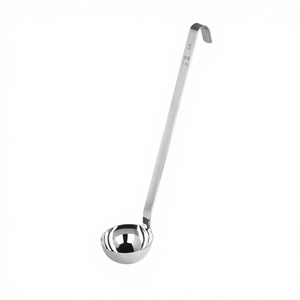
Formed from single-sheet deep drawing process. Eliminates seams and welds where food residue or bacteria could accumulate. Ideal for commercial ladles, food pans, and hotel buffet display sets.
Rooted in over 55 years of manufacturing excellence since 1966, our manufacturing network (including flagship brand lines Tanica and Edelmann) combines decades of stainless steel craftsmanship with international automated factory standards.
From custom handle molds to specialized multi-layer base encapsulation, our engineering team works directly with global brand procurement managers to manufacture customized commercial cookware solutions.
Key technological, environmental, and commercial shifts shaping global B2B cookware sourcing over the next decade.
With global commercial kitchens transitioning from open flame gas burners to high-efficiency magnetic induction cooktops to meet decarbonization targets, 100% full-surface induction-compatible base technology (AISI 430 / Ferritic cold-rolled bottoms) is becoming mandatory across all commercial cookware lines.
Global regulatory pressure (including EU REACH restrictions and US state-level bans on PTFE/PFAS chemicals) is accelerating the demand for non-stick alternatives. Advanced commercial cookware factories are deploying high-durability plasma-sprayed ceramic and mineral granite coatings engineered to withstand commercial dishwasher high-temp cycles.
Occupational safety regulations in commercial kitchens are driving innovations in handle architecture. Modern factories are integrating hollow stainless steel handles with thermal-break air vents and continuous spot welding, ensuring handles remain cool to the touch during prolonged cooking while eliminating food traps.
Institutional procurement divisions for global hotel chains (Marriott, Hilton, Accor) now enforce strict ESG (Environmental, Social, and Governance) audit criteria. Leading Chinese manufacturing partners provide verified material traceability certificates (MTCs under EN 10204 3.1) guaranteeing the use of prime virgin stainless steel coils free from hazardous heavy metal contaminants, supported by solar-powered manufacturing facility initiatives.
Expert technical answers to common procurement questions encountered by global buyers, importers, and brand owners.
For standard catalogue items (e.g., standard SS304 stockpots or ladles), MOQ ranges from 200 to 500 units per item size. For fully customized OEM orders requiring custom deep-drawing dies, brand embossing, or bespoke packaging, MOQs generally start at 1,000 to 2,000 units depending on raw material gauge and tooling complexity.
We provide chemical spectro-analysis test reports (MTC) with every production batch. Buyers can verify material authenticity using handheld XRF (X-ray Fluorescence) analyzers or chemical nickel testing reagents. Genuine 304 stainless steel contains a minimum of 8.0% Nickel and 18.0% Chromium, whereas 201 alloys substitute nickel with manganese, offering significantly inferior corrosion resistance in saline commercial cooking environments.
Primary international compliance standards include US FDA food contact compliance (GRAS / CPG 7117.05), European Union Regulation (EC) No 1935/2004, German LFGB food safety testing, and French DGCCRF standards. Additionally, commercial dishwasher resistance tests (EN 12875) and thermal shock testing protocols must be conducted for commercial certification.
Standard production lead times range from 30 to 45 days after deposit confirmation and pre-production sample approval. For repeat OEM orders with established tooling and pre-allocated raw material coils, expedited production cycles of 20 to 25 days can be scheduled.