
The Greater Los Angeles culinary landscape represents one of the most demanding and dynamic commercial foodservice markets globally. From high-density restaurant hubs in Downtown Los Angeles, West Hollywood, and Santa Monica to extensive catering infrastructures servicing Hollywood film studios, kitchen equipment is subjected to continuous operational stress. For enterprise procurement managers, restaurant group buyers, and hospitality equipment distributors in Southern California, selecting the ideal metallurgy for cookware is not merely an aesthetic consideration—it is a critical economic and food safety imperative.
While standard 304-grade (18/8) stainless steel has historically dominated entry-level cookware manufacturing, top-tier factories supplying the Los Angeles market have shifted decisively toward 316 Stainless Steel (UNS S31600 / Marine-Grade Stainless Steel). The structural key to 316 stainless steel's performance lies in its metallurgical composition: specifically, the strategic inclusion of 2.0% to 3.0% Molybdenum (Mo) combined with 16-18% Chromium and 10-14% Nickel.
Technical Metallurgy Key Takeaway: Molybdenum drastically enhances resistance to pitting and crevice corrosion in high-salinity and acidic environments. In coastal Los Angeles commercial kitchens—where airborne ocean salts combine with heavy usage of acidic marinades, reduction sauces, and citrus-rich menus—316 stainless cookware exhibits up to 400% greater corrosion resistance compared to standard 304 alternatives.
To provide actionable insights for wholesale procurement decisions, our engineering team has synthesized testing data comparing 316 Marine Stainless Steel with alternative commercial cookware materials utilized across Southern California kitchens:
| Material Grade | Chemical Composition | Pitting Resistance (PREN Value) | Acidic Food Reaction (pH < 4.0) | Thermal Stress Tolerance | Prop 65 Leach Risk |
|---|---|---|---|---|---|
| AISI 316 Stainless | 16-18% Cr, 10-14% Ni, 2-3% Mo | 23.0 - 25.0 (Superior) | Zero Chemical Leach / Inert | Up to 870°C (1600°F) | 0% Risk (Non-Toxic) |
| AISI 304 Stainless | 18-20% Cr, 8-10.5% Ni, 0% Mo | 18.0 - 20.0 (Moderate) | Micro-pitting over long exposure | Up to 870°C (1600°F) | Low Risk |
| Commercial Aluminum | 99% Al alloyed with Mn/Mg | N/A (Oxidizes rapidly) | Reactive (Requires coating) | Warps > 250°C (480°F) | Coating Degradation Hazard |
| Enameled Carbon Steel | Iron-Carbon Alloy + Glass Frits | N/A (Chip prone) | Inert until surface chips | Thermal shock sensitive | Lead/Cadmium risk if cheap glaze |
Because pure 316 stainless steel possesses low thermal conductivity (approx. 16.3 W/m·K) relative to aluminum (237 W/m·K) or copper (401 W/m·K), professional cookware factories employ advanced Multi-Ply Cladding Technology. High-performance 316 cookware manufactured for the LA commercial market typically incorporates a 3-Ply, 5-Ply, or 7-Ply composite structure:
Los Angeles is not a monolithic market; its culinary enterprise spans coastal fine dining, high-capacity institutional food service, suburban ghost kitchens, and eco-conscious residential retail. Our 316 stainless steel cookware solutions are purpose-engineered for these specific Southern California operational environments:
Venice Beach, Santa Monica Pier, Malibu, and Long Beach waterfront restaurants face severe airborne saline ambient humidity combined with seafood-heavy menus. 316 cookware prevents surface rust, pitting, and structural degradation caused by salt spray and citric acid exposure.
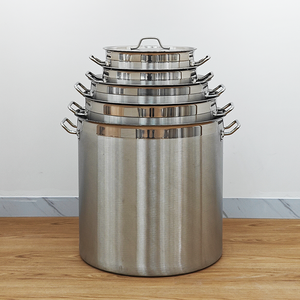
Culinary hubs in Downtown LA (DTLA) and Hollywood operate 18+ hours daily under intense thermal cycles. Heavy-duty 316 stockpots and pans resist bottom bowing, handle shear failure, and thermal warping under continuous commercial power burners.
Discerning home chefs in Pasadena, Beverly Hills, and Irvine actively seek non-toxic, PFOA-free, and heavy-metal-free alternative cookware. Premium 316 surgical stainless cookware fulfills consumer demands for non-leaching, pristine food preparation.
Navigating the cookware procurement landscape in California requires strict adherence to regulatory standards that are among the most stringent in the world. As a premier manufacturer supplying Southern California buyers, our production lines fully integrate compliance protocols tailored to local mandates:
California’s Safe Drinking Water and Toxic Enforcement Act of 1986 (Proposition 65) mandates strict limit thresholds on heavy metals including Lead (Pb), Cadmium (Cd), Nickel (Ni), and Cobalt (Co). Cheap non-stick coatings and low-grade recycled alloys pose severe leaching risks under high temperatures. Our 316 stainless steel cookware undergoes rigorous ICP-MS (Inductively Coupled Plasma Mass Spectrometry) testing to certify zero migration of toxic substances, granting complete exemption from warning label requirements.
The City of Los Angeles and surrounding municipalities have enacted progressive building decarbonization codes requiring new commercial food service operations to install high-efficiency electric induction cooking platforms. Our 316 cookware ranges feature full-disc impact-bonded or 5-ply cladding with magnetic stainless steel (AISI 430), ensuring optimal energy transfer efficiency (>90% thermal coupling) on induction hobs while lowering operating HVAC load costs in LA kitchens.
Supply chain resilience is vital for West Coast distributors. Located with direct deep-water shipping access from Indonesia, our global manufacturing plants offer direct ocean freight lanes straight to the Port of Los Angeles (POLA) and Port of Long Beach (POLB). This strategic maritime link reduces transit lead times to 18-22 days, avoiding overland transport bottlenecks and offering substantial tariff optimization compared to mainland routes.
With an operational legacy spanning over 58 years since our founding in 1966, PT Indonesia Utensil stands as a premier global OEM/ODM manufacturer specializing in high-grade stainless steel kitchenware and foodservice utensils. Operating out of our expansive manufacturing complex in Bandung, Indonesia, with centralized marketing hubs in Jakarta, our brands—Tanica and Edelmann—are globally recognized for unyielding craftsmanship and metallurgical integrity.
Equipped with 1,000+ ton hydraulic presses, automated deep-drawing machinery, and laser seam welding systems capable of manufacturing seamless stockpots up to 100-liter capacity without structural weak points.
Every production batch is tested for structural tensile strength, thermal shock endurance, and chemical corrosion resistance under NSF/ANSI Standard 2 for food equipment safety compliance.
Full-spectrum custom manufacturing including laser logo etching, bespoke handle ergonomic molding, custom color PVD coatings, and eco-friendly FSC-certified retail packaging design.
Elevate your product catalog with high-margin, marine-grade 316 stainless steel cookware. Reach out to our B2B export team today for factory-direct pricing, custom OEM samples, and freight quotes to Los Angeles.